Five of Swords and Six of Swords Combination in Tarot
The Five of Swords and Six of Swords tarot combination meaning: general sense, in love and work, every reversed variant, and advice.
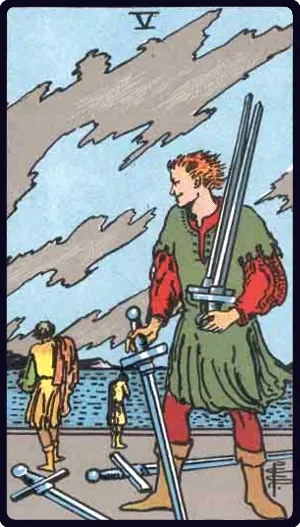
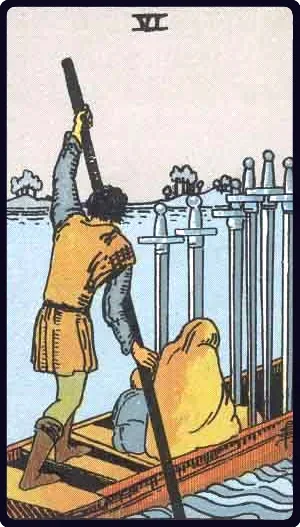
In short. The Five of Swords shows a bitter conflict with no winners, while The Six of Swords carries you away from the storm toward calmer water.
This pairing is about closing a hard chapter. The Five of Swords is a dispute where everyone lost more than they won, while the Six of Swords is the passage from tension to peace, the crossing to a new shore. When they fall together, the matter is almost always that the sharp phase of the clash is over and it is time to sail away from where it hurt. The cards promise no instant relief, but they point clearly in one direction: from hostility toward quiet.
General Meaning of the Combination
At the core of the pair sits a simple formula: the bitterness of the Five plus the transition of the Six equals a deliberate way out of conflict. The Five of Swords marks the moment when the fight has exhausted itself and victory brought no one joy, while the Six of Swords signals there is no reason left to stay on the battlefield. Together the cards say you are ready to lay down your weapons and carry off only the lesson, not the grudge. The pairing often appears when a person decides to walk away from a draining situation: a workplace blowup, a drawn-out quarrel, an environment where they had to keep defending themselves. This is not flight but a sober step toward recovery. The six swords still lie in the boat, the weight of what happened has not vanished, but it no longer drags you under. The deeper message is that peace is worth more than a proven point.
In Love and Relationships
In relationships the combination speaks of reconciliation after a hard falling-out, or a calm parting with no fresh war. The Five of Swords shows a couple worn down by mutual blame and the urge to be right, while the Six of Swords leads them out of that deadlock into a quieter phase. Sometimes the partners leave the conflict behind together and rebuild trust, slowly letting go of the barbs. Sometimes the point is to separate without a scene, having realized that together they only wound each other. For singles the cards advise sailing away from old bitterness and not dragging former scores into new connections. Either way the direction is the same: from the quarrel toward peace.
In Work and Finances
In work the pair speaks of stepping out of a toxic standoff. The Five of Swords paints a team full of intrigue, where victory costs you ruined relations, while the Six of Swords suggests it is wiser to change your surroundings than keep up the war. This may mean moving to another department, leaving a role where you had to fend off attacks, or deciding not to enter office skirmishes anymore. In finances the combination speaks of a gradual settling after a money dispute: the conflict winds down, sometimes through concessions, and your footing steadies. The point is not to cling to the battlefield on principle but to move calmly toward a new foundation.
If a Card Is Reversed
The Five of Swords reversed, The Six of Swords upright
The conflict is already loosening its grip, and the transition comes more easily than expected. The reversed Five carries remorse and a readiness to reconcile, while the upright Six ferries you out of the hard stretch. The weapons are down, and you sail toward a new shore with no cargo of revenge. In love it is warm reconciliation, in work it is the quiet close of an old dispute.
The Five of Swords upright, The Six of Swords reversed
The sharp conflict still rages, and there is no getting away: the boat is stuck against the shore. The upright Five holds you in the dispute, the reversed Six shows the inability to move. You want to leave the quarrel behind, but stubbornness pulls you back again and again. In love it is a couple circling through the same rows, unable to make peace or to part, in work it is being stuck in a toxic place you should have left long ago.
Both cards reversed
Both the conflict and the transition stall: you seem tired of fighting yet cannot move forward. The reversed Five carries unspoken resentment, while the reversed Six shows an attempt to run without solving anything. The old bitterness tags along, and a change of scene changes nothing. In love the grievance keeps smoldering after a breakup, in work it is leaving with no lessons learned, where the same conflicts repeat.
The Cards' Advice
Lay down your weapons and sail. The Five and Six of Swords together advise you to accept that the fight has run its course and to step calmly out of the draining situation. Do not haul the grudge along as ballast: take only the lesson. Move toward the new shore without one last urge to prove a point, and the transition will bring real relief rather than a rerun of the old war in a new place.