Lenormand Card Combinations
The meaning of Lenormand card combinations in readings: how a pair of cards reads together in love, relationships, work and money.
All combinations
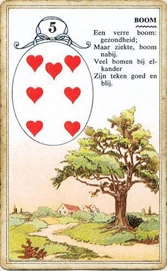
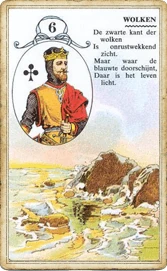
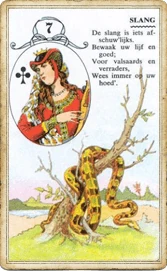
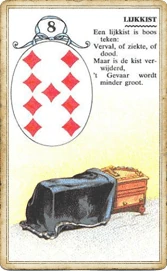
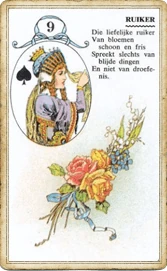
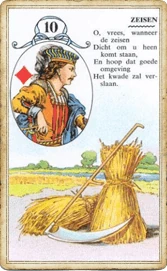
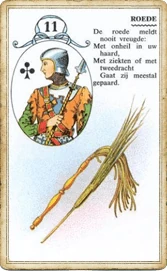
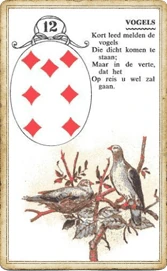
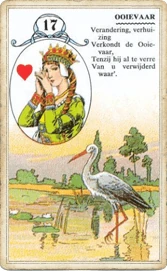
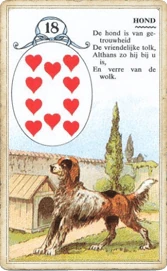
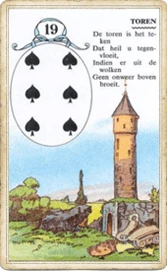
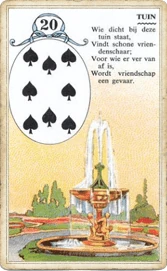
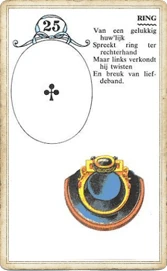
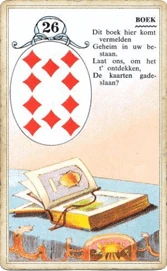
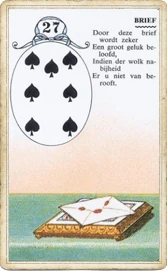
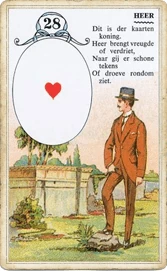
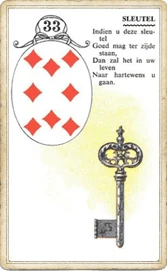
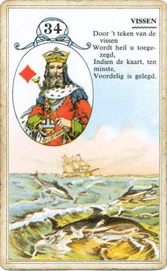
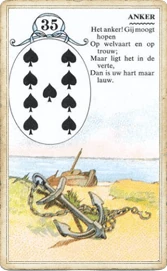
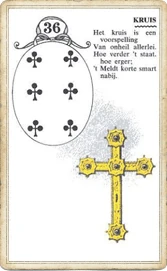
Lenormand cards barely work on their own. A lone Ship is just the word "travel." A lone Key is just "a solution." The meaning only comes alive when cards sit side by side and start qualifying each other. So the real skill in Lenormand is not memorizing definitions, it is learning to read a pair of cards as one short phrase.
The deck has 36 cards, and they form 630 unique pairs. Each pair is a little sentence: one card names the subject, the other describes it. Master pairs and everything else opens up, the three-card lines, the longer rows, the full Grand Tableau, because they are all built from that same brick. The whole system rests on the ability to fuse two images into a single meaning.
This page explains the combination method in plain language. You will learn why Lenormand is read in pairs, how the noun-and-adjective rule works, why swapping the cards changes the answer, which cards brighten a reading and which darken it, and how a pair scales up to a triad and beyond. At the end you will find working example pairs that link to the individual card meanings and to ready-made combination pages.
Think of combinations as grammar. If a card's keyword is a word in the dictionary, then a pair is a phrase and a spread is connected prose. Learning that grammar is easier than it looks. You only need a few simple rules and plenty of practice.
Why Lenormand Is Read Almost Only in Combinations
In Tarot every card stands alone. The symbolism is rich, the shades of meaning run deep, and even a single drawn card gives a full answer. Lenormand works the opposite way. The image is narrow and literal, and it lacks the depth to carry a whole reading by itself. The Fox means work and cunning, but until a second card sits beside it, you cannot tell whether it points to a new job, a sly colleague, or simply being careful at work.
The unit of meaning in Lenormand is not the card, it is the pair. A reader does not interpret each card in isolation, they build a phrase and read it whole. An experienced practitioner who draws a single card will almost always pull a second one to get some context. The first card sets the topic, and the second answers the question "what about it" or "what is happening with it."
This has a pleasant side effect. Lenormand has no reversals, which removes half the memory load, since you never track two sets of meanings per card. In exchange you pick up the one skill the whole system is built around: reading cards in combination. A card is softened or sharpened not by being upside down but by its neighbor. Next to the Bouquet even a hard card warms up, and next to the Clouds even a kind card dims.
This is exactly why the combination pages on this site are more useful than single-card entries. They show what happens when two images meet and what meaning is born at the seam. Look, for example, at the Ship and House page to see how two plain words come together into a concrete story about a move or a homecoming.
The Noun-Plus-Adjective Method
The core method for reading a pair is simple and almost grammatical. The first card acts as a noun, naming the subject. The second card acts as an adjective, describing that subject. You read the pair left to right: the thing first, then its quality. The pattern follows French word order, where the adjective tends to come after the noun.
Take the Sun and the Letter. With the Sun first, the topic is success, joy, clarity, and the Letter qualifies it: success arrives as a document or a message. You get "good news in writing," a contract with a happy outcome, a cheering letter. Now flip the order. With the Letter first, the topic is a document or piece of news, and the Sun colors it bright. You get "good news," a letter with a happy content. The subject of the sentence has shifted, and the phrase reads differently.
The same principle holds for any pair. House plus Fox is home as the topic and work as the qualifier, so it reads as working from home, a household chore, or cunning within the family. Heart plus Key is love as the topic and an important decision as the qualifier, so it reads as a turning point in feelings. Do not rush to a polished interpretation. Say the literal phrase first, subject then quality. In Lenormand the blunt reading is almost always truer than the elegant one.
Tip. Say the pair aloud as "a noun, what kind." The first card answers "what is this," the second answers "what is it like." If the phrase sounds clumsy but on point, you are on the right track.
Why Card Order Changes the Meaning
This is probably the single most important rule of combinations, and the one beginners miss most often. In Lenormand the order of the cards is not a formality. The first card sets the subject and the second qualifies it, so swapping two cards shifts the stress and sometimes the whole meaning of the phrase.
A classic example: Tower plus Book. The Tower is an institution or official structure, and the Book is knowledge, study, a document. In the order Tower plus Book you get an "institution of knowledge," a school, a university, a library. Reverse it, and Book plus Tower reads more like "hidden knowledge about an institution," a confidential file, sealed information about an organization. Same two cards, different meaning, because the subject of the sentence has changed.
This is why our combination pages always include a "Direct and Reverse Order" block. We work through both sequences separately so you can see how the emphasis moves. Compare how Key and House reads each way: "home as an important event" points to settling a property matter, while "an important decision about the home" points to a specific household issue that has finally moved forward. In practice the two readings are close, but their stress and tone differ, and in a live spread that difference is often the answer.
When you lay several cards in a row, read them in the order they fell and do not rearrange them. A card to the left of your topic usually speaks of the past and the causes, a card to the right of the future and the consequences. Same direction as reading a pair: left to right, from subject to development.
The Descriptive and Intuitive Methods
Reading pairs has two modes, and both are useful at different stages. The descriptive, or grammatical, method is the noun-plus-adjective scheme itself. You take the keywords of both cards and mechanically link them into a phrase. This approach is indispensable for beginners: it keeps you from drifting into fantasy, holds the reading close to the cards' real meanings, and trains you to read literally. Until the images are burned into memory, lean on it.
The intuitive method comes later. Once you have read pairs by the scheme hundreds of times, your mind starts recognizing combinations whole, the way a fluent reader recognizes a word without spelling it out. You see the Snake next to the Ring and immediately feel "a troubled union, deception in a contract," without reciting the formula. That is the same grammar driven to automatic speed by practice.
The key is not to skip ahead. If you start with intuition and bypass the descriptive stage, your readings drift: you say what you want to see rather than what the cards say. So the rule is simple. Read literally first, trust intuition later. Even a seasoned reader facing a hard combination can fall back on the basic formula to check their work. The descriptive method is the foundation, the intuitive one the upper floor, and neither stands without the other.
Brightening Cards and Warning Cards
Not all cards in a pair carry equal weight. Some pull a reading toward themselves more strongly than others, brightening or darkening their neighbors, and you should account for this before you dig into the details. Gauge the overall tone of the surrounding cards first, then refine the specific pair.
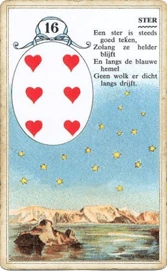
Bright cards lift any combination. The Clover, the Sun, the Bouquet, and the Stars dilute anxious neighbors and promise a favorable outcome. Next to a card like these, even a hard card loses half its sting. The Key stands apart: it does not so much brighten as amplify and confirm. The Key beside any card stamps it with "this will certainly happen, this matters," so its presence always underlines the importance of a pair.
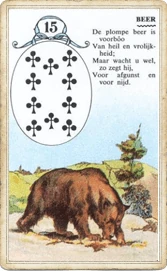
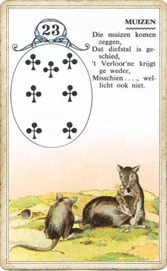
Warning cards do the opposite, darkening the combination and flagging caution. The Clouds add confusion, the Snake hints at deception or a difficult person, the Scythe warns of a sharp break, the Coffin speaks of an ending, and the Mice point to loss. These cards are not a verdict, but they color the pair with an anxious tone you cannot ignore. A strong figure like the Bear can work both ways: as protection and support, or as pressure and jealousy, depending on the company it keeps.
The practical takeaway is this. Before you parse a pair by the formula, ask yourself what tone it carries. A bright neighbor softens even an unpleasant topic, an anxious one adds a drop of bitterness even to good news. This balance is exactly how you build a yes or no answer when there is no rigid table at hand.
From Pairs to Triads and Bigger Spreads
The pair is the basic brick, but real spreads are usually longer. The good news is that larger combinations read by the same rule, there are just more bricks. Once you have mastered pairs, you automatically hold the key to everything else.
In a triad the center card usually carries the topic and the flanking cards qualify it. Read it as an extended phrase: subject, quality, outcome. The Bear between the House and the Fish is a question of household finances, a powerful person who controls the money at home. Build a triad from two pairs that share the center card, then link them into one sentence. If pairs read easily, triads assemble themselves.
A line of five, seven, or nine cards is a full sentence read from start to finish. Name each card's meaning, then connect them into coherent prose around your question. The summit of the system is the Grand Tableau, all 36 cards at once. It looks daunting, but it is the same pair method scaled up. You begin with the significator, usually the Man or the Woman, find its place, and read the nearest neighbors. Anyone who can read pairs can handle the big table, it just takes more time.
Common Combinations and Examples
To feel the method in action, here are a few working pairs. Notice how the subject-plus-qualifier formula runs through each one, and how the color shifts with the neighbor.
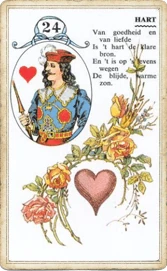
- Heart plus Key is love as the topic and an important decision as the qualifier, a turning point in feelings, a confession, a firm yes in a relationship. More on the Heart and Key page.
- Ship plus House is travel as the topic and home as the qualifier, a relocation, a homecoming, a change in domestic life.
- Snake plus Fish is deception as the topic and money as the qualifier, murky finances, a shady deal, caution in money matters.
- Bouquet plus Ship is joy as the topic and travel as the qualifier, a pleasant trip, a happy journey, a longed-for departure.
- Bear plus House is strength as the topic and family as the qualifier, a powerful figure in the home, a source of support and protection, the care of an elder.
- Ring plus Scythe is a union as the topic and a sharp break as the qualifier, a contract cut short, a broken engagement, a sudden separation.
In each pair the first card names what the matter is about, and the second answers what is happening with it. That is the entire method at work. A full reading of any of the 630 pairs, with both reading orders, lives on its own combination page, linked from our spreads and the card meaning pages.
How to Practice Reading Pairs
The best way to learn combinations is a short daily drill. Draw two cards at random and build a phrase out loud: the first card is the subject, the second is the qualifier. It does not matter whether you have a question, what matters is the mechanics of linking two images. At first the phrases will come out clumsy, and that is fine. A clumsy but accurate reading beats a pretty but invented one.
Raise the difficulty once the basic pairs flow. Draw the same two cards, then swap them and say both versions aloud. This trains your sense of order, the key skill in Lenormand. Check yourself against our combination pages too: read your own interpretation, then look at the "Direct and Reverse Order" block and see whether the stress matched.
Keep a pair journal. Write down the combination you drew, your interpretation, and, if there was a question, how things turned out. Come back in a couple of weeks and compare. This review teaches faster than any book, because it shows you your own strengths and blind spots. After a month or two of steady practice, pairs resolve into phrases almost instantly, and that is when you can move on to triads and bigger spreads.