Business — Lenormand Reading

A business is built on small things. Not grand strategies or bold visions but the ordinary circumstances that either quietly push you forward or slowly pull everything apart. A lease that eats too much margin, a supplier who cannot keep a deadline, a team member who generates more friction than output. Each factor on its own looks manageable. Together they form a pattern where your effort goes in and nothing comes out. A free online Lenormand card reading deals with exactly these kinds of details. Lenormand cards do not paint sweeping forecasts or promise distant breakthroughs. They show what is happening around your business right now, in plain, everyday terms. Five cards in the spread will pinpoint why your venture is stuck, where income is most likely to appear, who in your circle is slowing things down, and which routine details you have trained yourself to ignore. Every Lenormand card represents a concrete part of daily life: a letter, a house, a tree, a fox. Combinations read like familiar situations rather than abstract symbols. This business reading is worth trying when everything looks like it should be working but the results say otherwise. The spread will show you which piece has fallen out of the machine and where to start so the whole thing runs properly again.
Your Reading Is Ready

1Why is my business stuck?
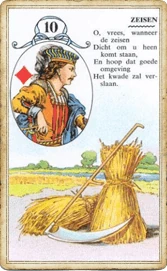
2Where will the money come from?
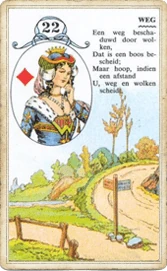
3Who around me is hurting the business?
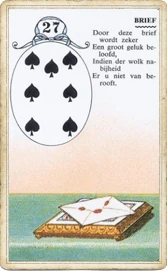
4What details am I overlooking?

5What should I change first?
Save Your Reading
Recommended
Total 10









Guess the Card Meaning
Lenormand Reference








What the reading reveals
-
Why is my business stuck?
The practical, ground-level reason your business is not moving. Not the big-picture strategy but the one small thing that jams the whole machine. A bad lease, an unfavorable contract, a person dragging the process down.
-
Where will the money come from?
Where revenue is realistically going to show up next. A returning client, an overlooked sales channel, a side offer you dismissed too quickly.
-
Who around me is hurting the business?
Someone in your immediate circle whose presence creates friction for the business. Not necessarily an enemy. Sometimes it is simply a person taking up space without contributing anything useful.
-
What details am I overlooking?
Minor circumstances you have grown used to ignoring but that quietly compound into a real problem. One overdue payment, one unhappy client, one broken promise.
-
What should I change first?
The single practical step worth taking before anything else. Not a full overhaul of the business but one specific move that sets off a chain reaction of improvement.
When to do a reading
Clients are coming in but money is not
Orders come in, work gets done, and yet the bank balance looks roughly the same at the end of every month. Costs swallow everything you earn. The workload seems healthy, but profit leaks out through a dozen tiny holes, each one too small to notice on its own. Where exactly the money disappears is something you have not figured out yet.
A new hire is causing problems
The hire seemed solid at first. Onboarding went smoothly, the first couple of weeks were fine. Then things started slipping. Tasks come back half done, colleagues grumble, clients get a worse experience. Letting the person go feels wasteful after the training investment. Keeping them feels more expensive by the week.
Small issues keep piling up
Any one of them is nothing. A printer breaks, a shipment arrives late, a customer cancels at the last second. But when five of these land in the same week, you realize half your working hours go toward putting out fires instead of building anything new.
Your supplier keeps letting you down
Late again, three days this time. Quality on the last batch was off too. You have wanted to switch for months, but your product is niche, competitors offer worse terms, and the transition would take forever. Easier to put up with it for now, except patience is running out.
The business runs fine but you are burned out
Revenue is solid, customers are happy, operations run on autopilot. Yet every morning you have to force yourself to open the laptop. The excitement from year one burned away long ago, replaced by a mechanical loop of the same tasks. Staying for the money works, but how long before that stops being enough?