Eight of Swords and The Hanged Man Combination in Tarot
The Eight of Swords and The Hanged Man tarot combination meaning: general sense, in love and work, every reversed variant, and advice.
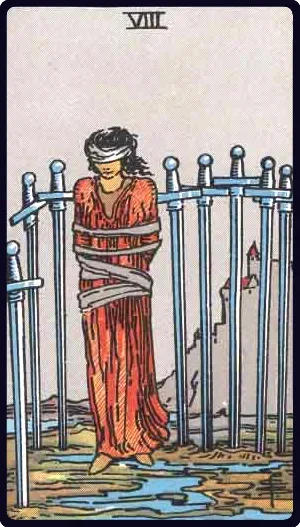
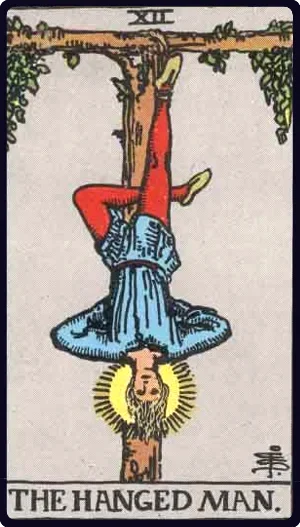
In short. The Eight of Swords paints a trap built of fears, while The Hanged Man asks you to shift your angle, marking a dead end whose exit opens once you see it differently.
This is an instructive, psychological pairing. The Eight of Swords carries the feeling of being cornered, when a person convinces themselves there is no way out, while The Hanged Man offers to stop and look at the walls differently. When the cards meet, the barrier lives in the mind, not in the world, and the key to freedom is a change of angle. This is not a real cage but imagined helplessness that dissolves the moment you lift the blindfold and look around clearly.
General Meaning of the Combination
At the core of the pair sits a simple formula: the imagined trap of the Eight of Swords plus the change of angle of The Hanged Man equals a way out of a dead end that once seemed hopeless. The Eight of Swords shows that the person has cornered themselves with fears and other people's voices, while The Hanged Man says that if you stop and view the situation from another angle, the walls turn out to be imaginary. Together the cards say there is always an exit, simply unseen from the usual pose. The pairing often appears when a person is stuck in anxiety and has convinced themselves there is no choice while the doors stand open. It is an invitation to shift your point of view and notice the gap. The Hanged Man lifts the blindfold of fear, while the Eight of Swords reminds you that the key to the cage has been in your hand all along.
In Love and Relationships
In relationships this pairing speaks of an imagined hopelessness held together by fear. The Eight of Swords convinces the person that they cannot cope without their partner or that leaving is impossible, while The Hanged Man asks them to honestly see what truly holds them in place. For a couple it is a stagnation where both stay silent, afraid of the honest talk that would open the exit. Sometimes a pause is needed to see the relationship from a new angle and tell whether the barrier is real or invented. For singles the cards advise releasing the fear of loneliness that paints walls where there are none. A sober view from the outside frees you more than any struggle.
In Work and Finances
In work and finances the pair speaks of a dead end that exists only in the mind. The Eight of Swords insists that you cannot change jobs, that nothing better exists, while The Hanged Man advises you to review the situation from a new angle. A person may be stuck in disliked work out of a fear of change, though the exit is near. In money matters the combination warns that imagined helplessness keeps you from seeing real options, and advises letting the anxiety settle and looking around soberly. This is not a real collapse but self-deception that dissolves once you shift the angle. The point is to lift the blindfold and notice that the swords never closed the circle.
If a Card Is Reversed
The Eight of Swords reversed, The Hanged Man upright
A way out has already glimmered, but the person delays and drags out the step, turning the release into endless waiting. The blindfold slips, the fear loosens, yet the will to finally move is missing, and the pause stretches on. In love it is realizing that only invented fears hold the relationship together, and hesitating to let them go, in work it is a conscious exit endlessly postponed instead of being taken.
The Eight of Swords upright, The Hanged Man reversed
The trap is felt at full force, but the pause has turned into stubborn stagnation: the person sees the walls and refuses to shift their view to notice the gap. Fear holds them, and the flexibility of perspective is missing. In relationships it is getting stuck in an imagined hopelessness, where the honest talk is long overdue yet avoided, in work it is clinging to an old view that leaves the real exit unnoticed.
Both cards reversed
Both the trap and the pause are blocked: the person is cornered by fear and clings stubbornly to the usual pose, so everything freezes in a dead end. There is not enough strength to get out, and the change of angle is blocked. In love it is stagnation and a dread of the frank talk that is long overdue, in work it is paralysis and a build-up of unsolved problems that will eventually burst out all at once.
The Cards' Advice
Lift the imaginary blindfold and look around soberly. The Eight of Swords and The Hanged Man together advise you not to fight the barrier with force but to shift your angle: most often the walls that hold you in place are invented by fear. Stop, ask yourself what truly hinders you, and take one step. The key to the cage has been in your hand all along; you only need to dare to turn it.