Death and Seven of Swords Combination in Tarot
The Death and Seven of Swords tarot combination meaning: general sense, in love and work, every reversed variant, and advice.
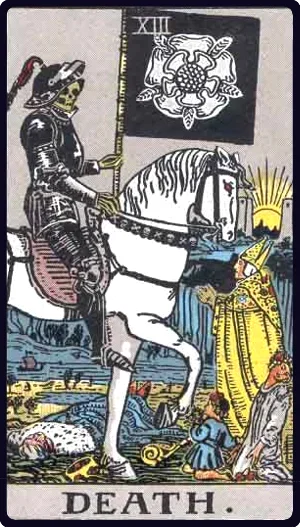
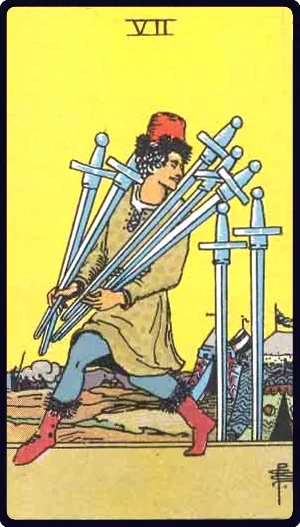
In short. Death closes an outworn chapter, while the Seven of Swords slips away by the back route, so together they speak of a quiet exit and fleeing from an honest ending.
This pairing is about a close that someone tries to stage quietly and unseen. Death ends what has run its course, and the Seven of Swords chooses a stealthy exit over an open talk. Together the cards show how a person slips away from the reckoning, unwilling to meet it face to face. Sometimes it is a sensible strategy, more often a cowardly dodge that leaves a trail of mistrust behind.
General Meaning of the Combination
At the core of the pair sits a simple formula: the ending of Death plus the cunning of the Seven of Swords equals a quiet exit from what should end in the open. Death says the chapter is over, while the Seven of Swords specifies how the person meets that ending: not directly but by the back route, on the quiet, through calculation. The combination often appears when the reckoning is inevitable, yet instead of an honest finale someone prefers to slip away without explanation. This can be a wise way out of a situation where an open fight is pointless, or it can be a flight from responsibility and a fear of facing the truth. Death removes the outworn, and the Seven of Swords suggests the workaround, and whether it is honest or cowardly decides whether a clear conscience or a trail of deception remains after the exit.
In Love and Relationships
In relationships the combination speaks of a quiet, stealthy parting. Death closes the bond, and the Seven of Swords shows that one of the two leaves in silence, with no explanation, sometimes even preparing the retreat in secret beforehand. It can be a vanishing with no talk, a hidden affair as a way out of a cooled union, or an exit dressed in half-truths. No open goodbye happens, and the other is left in the dark. For singles the cards advise staying alert: a new person may be quietly ending a prior relationship or running a double game. The pairing hints that an honest finale beats a quiet disappearance, even when the direct talk is harder.
In Work and Finances
In work and finances the pair speaks of an ending that runs stealthily and by the back route. Death closes the chapter, and the Seven of Swords shows a quiet exit: a person leaves a project unnoticed, takes their work along, or moves to a competitor without announcing it openly. Sometimes it is a calculated strategic exit, where it is wiser to keep plans quiet until the last moment. More often the card hints at fleeing responsibility for a failure or an exit that leaves mistrust behind. In money the combination warns of hidden losses when closing a venture: something is concealed, agreements are skirted. The key is to end honestly, since a stolen advantage rarely holds for long.
If a Card Is Reversed
Death reversed, Seven of Swords upright
The ending is overdue, but the person stalls it while still scheming, hiding their true intentions and running a double game instead of releasing the old. The close is postponed, and the tricks multiply. In love it is stealthy indecision, where one secretly prepares an exit yet won't commit to a breakup and keeps the partner in the dark, in work it is concealing plans and intrigue around a matter that should long have been honestly closed.
Death upright, Seven of Swords reversed
The ending runs its course, and the hidden surfaces: the deception is exposed, the masks fall, and the secret exit becomes plain. This is a reveal after which one must answer for the half-truths, yet it opens the road to an honest finale. In relationships it is the truth of a hidden exit coming out, after which the pair can part openly, in work it is an exposed intrigue, after which the ending proceeds in the clear, with no double bottom.
Both cards reversed
Both the ending and the cunning are blocked: the person sees the chapter is over yet hides behind tricks and won't let the truth surface, so everything freezes in half-truths. In love it is stagnation in a union where both conceal something and neither dares an open breakup, in work it is paralysis around secret maneuvers, where the old is not closed and the new never begins.
The Cards' Advice
Do not slip away from the reckoning through a side door. The Death and Seven of Swords together advise you to meet the ending openly rather than flee on the quiet: a stealthy exit looks easy but leaves mistrust and unfinished business behind. Tell the truth plainly, even when it is harder, and close the chapter cleanly, and then a clear conscience remains after the end rather than a trail of deception.