Ten of Swords and Ten of Wands Combination in Tarot
The Ten of Swords and Ten of Wands tarot combination meaning: general sense, in love and work, reversed cards, and advice when overload reaches total exhaustion.
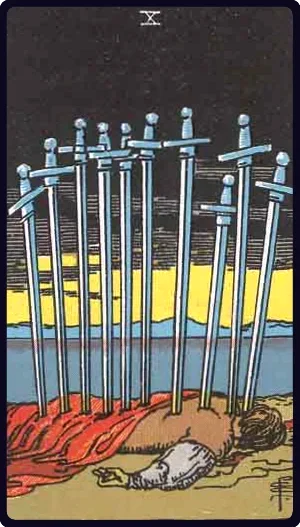
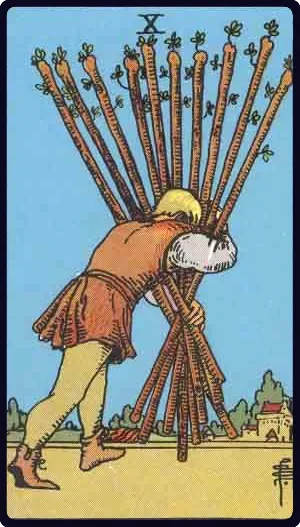
In short. The Ten of Swords shows collapse and rock bottom, while The Ten of Wands shows a heavy load, so together they mark an overload driven to total exhaustion.
This combination is about fatigue that has reached the very bottom. The Ten of Wands hauls ten staves to the last. The Ten of Swords marks the point where the strength is gone: the person falls, the load can no longer be held, and collapse arrives. Together the cards describe the finale of a draining chapter that ended not in victory but in depletion. It is a heavy pair, yet it holds a mercy: the bottom is behind you, and the only way from here is up.
General Meaning of the Combination
At the core sits a simple formula: the burden of the Ten of Wands plus the collapse of the Ten of Swords equals total exhaustion, where overload drives you to the breaking point. The Ten of Wands shows you carried too much for too long, while the Ten of Swords announces that the road has come to a painful end. Burnout to ashes, the fall of a project or bond that rested on your last reserves, or a physical breakdown after long overexertion are all possible. This is the card of rock-bottom fatigue, where pretending you are coping is no longer possible. Yet both tens close a cycle, and there is hope in that: what wore you down is ending for good. After such a finale you no longer have to haul the old load, because it is gone. The combination advises accepting that the chapter is closed and not trying to revive what has spent itself.
In Love and Relationships
In relationships the pair speaks of a bond that ran on someone's overstrain and finally fell under its weight. The Ten of Wands carried the household, the care, and the decisions to the limit, while the Ten of Swords marks the painful end: a breakup, a betrayal, or the final burnout of feeling. One partner gave everything and can give no more; the relationship has spent their resource. For singles the combination shows deep fatigue from a past bond that needs time to recover from, not a fresh sprint. The card advises not to cling to what wore you down but to acknowledge the end and let yourself heal the exhaustion before building again.
In Work and Finances
In work and finances the combination describes overload driven to collapse. You hauled several projects to the breaking point and a breakdown followed: a dismissal, a failed venture, or full burnout that makes working impossible. The Ten of Wands shows the draining labor, while the Ten of Swords shows its painful finale, where the resource is spent to the bottom. In money it is a loss or a reset brought on by excessive commitments and work at the limit. But the end here is final, and therefore freeing: the draining scheme will not return. The card advises not to push on the old course but to acknowledge the bottom and begin recovery with a clean slate.
If a Card Is Reversed
Ten of Swords reversed, Ten of Wands upright
The worst is behind you and recovery begins, but part of the load remains: you are clawing up from the bottom, yet familiar obligations still press. Strength returns slowly, and it matters not to shoulder the old volume at once. In love it is healing after a painful split while household duties persist, in work it is a gradual climb out of burnout, where tasks remain but the catastrophe has passed.
Ten of Swords upright, Ten of Wands reversed
The load begins to lift, and the collapse turns out to be a release: the heavy chapter falls apart, but the unbearable burden falls away with it. The painful end coincides with long-awaited relief, and beneath the rubble a chance to breathe opens up. In relationships it is a breakup that is hard yet lifts the accumulated weight, in work it is the close of a draining task after which you can finally drop your shoulders.
Both cards reversed
Both the collapse and the overload are easing at once: the bottom is behind you, the load lifts, and real recovery begins. Yet the process drags, and the person is slow to come back to themselves after a stretch at the limit. In love it is slow healing and a cautious return of trust, in work it is a gradual revival of strength, where the old road is over and the new one is felt out without haste.
The Cards' Advice
Accept that the bottom is behind you, and do not try to revive what has spent itself. The Ten of Swords and Ten of Wands together advise you to take the end of a draining chapter as a release rather than a catastrophe. You carried too much for too long, and now the load falls away on its own. Give yourself time to recover, do not shoulder the old volume, and build anew only when your strength returns. It cannot get worse; the only way from here is up.