Four of Cups and Ten of Swords Combination in Tarot
The Four of Cups and Ten of Swords tarot combination meaning: general sense, in love and work, every reversed variant, and advice.
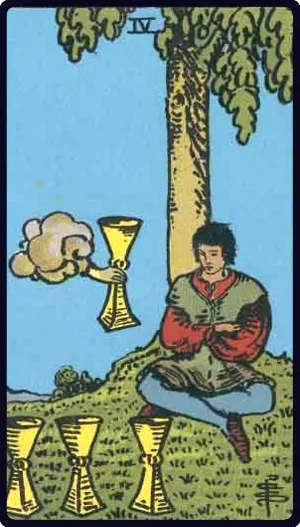
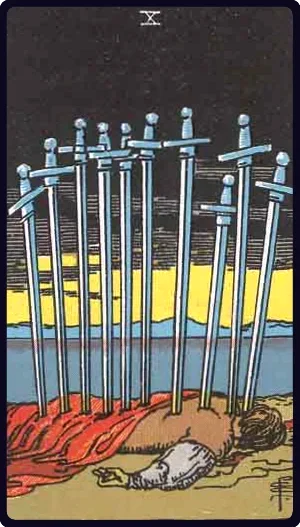
In short. The Four of Cups shows pent-up fatigue and boredom, while The Ten of Swords drives it to its limit, so together they mark a painful ending after which the dawn begins.
This combination is about how a drawn-out standstill breaks off in a sharp collapse. The Four of Cups stores dull discontent, ignores the gift held out, and sits in a shell of brooding, while the Ten of Swords puts a hard full stop to the story. What the person endured out of apathy finally falls apart, and painfully so. Yet both cards hint at light beyond the horizon: rock bottom is reached, and dawn follows the darkest night.
General Meaning of the Combination
At the core of the pair sits a simple formula: the apathy of the Four of Cups plus the collapse of the Ten of Swords equals a forced ending of something long outworn. The person stared at the ground too long and ignored the signals, and pent-up fatigue finally burst out as a painful finale. Often it is a breakup, a job loss, or a betrayal that struck without warning, even though it had been ripening for a long time. The Ten of Swords says honestly that a good outcome is unlikely and that it is time to accept defeat, while the Four of Cups explains why it sank to the bottom: indifference piled up in place of action for too long. The core message of the pairing is not catastrophe but release. What collapsed rested on emptiness and habit, and now that it has fallen away, the road to the new opens. Do not cling to the wreckage; let the old story close.
In Love and Relationships
In relationships this combination describes an ending that ripened in silence. First came cooling and boredom, partners lived side by side out of habit, and then everything broke off sharply, like a blade in the back. The Ten of Swords speaks of a breakup or betrayal that leaves the bond beyond repair, while the Four of Cups shows the crack grew from long indifference rather than a single mistake. For singles the pair shows someone who closed off after old pain and never let the past go. The heart grew so tired that it chose to shut a painful chapter itself. The cards advise against clinging to what is broken and suggest letting yourself grieve.
In Work and Finances
In work and finances the combination warns of a collapse brought on by prolonged listlessness. The person lost interest long ago, ran on autopilot, and ignored the warning signs, and in the end a project failed or a position slipped away. Sometimes the blow comes from colleagues you counted on, but more often it is the natural result of long burnout. The Ten of Swords says the old strategy has run its course and there is no sense fighting for what has fallen. In money matters the pair warns of losses and advises against large expenses until things settle. Better to accept the end of this chapter and prepare for a fresh start that is already close.
If a Card Is Reversed
The Four of Cups reversed, The Ten of Swords upright
The person had only just begun to shake off apathy when a sharp ending struck. Interest barely returned, yet the old structure had already collapsed, which stings all the more. Still, the awakening helps them meet the blow soberly rather than in a daze. In love it is a painful breakup just as they wanted to grow close again, in work it is the ruin of a venture they had only just rediscovered.
The Four of Cups upright, The Ten of Swords reversed
The worst is already behind, the bottom has been touched, but apathy keeps the person from seeing it and rising. Strength slowly returns and the threat proved smaller than it seemed, yet they still sit in the shell, holding on to past pain. In relationships it is a drawn-out grieving of a breakup that is essentially over, in work it is a slow recovery that stalls from a reluctance to risk again.
Both cards reversed
Both the standstill and the collapse lose their edge: the hardest blow landed earlier, apathy recedes, and the person emerges from hibernation with new perspective. The strength appears to look at old pain from a distance and finally release it. In love it is a willingness to risk again after a long closure, in work it is a calm rebuild after the crisis, when indifference and the sense of defeat fade and a sober plan takes their place.
The Cards' Advice
Do not hold on to what has already collapsed. The Four of Cups and Ten of Swords together advise you to accept the ending and live through the pain rather than bottling it up. What fell away rested on emptiness and habit for too long, and the road is now cleared. The bottom has been reached, so things get easier from here; gather your strength, review the mistakes, and take the first step toward a new chapter.