Five of Wands and Ten of Swords Combination in Tarot
The Five of Wands and Ten of Swords tarot combination meaning: general sense, in love and work, every reversed variant, and advice.
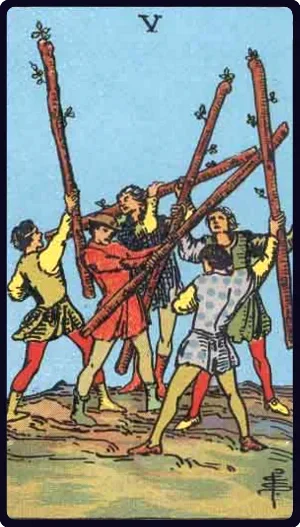
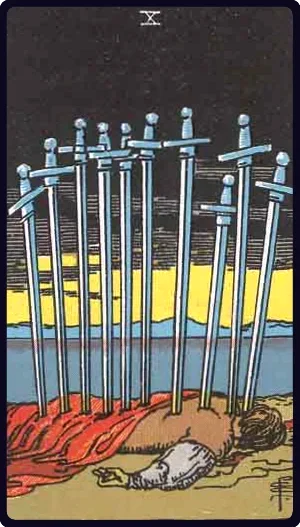
In short. Five of Wands brings a drawn-out struggle, while Ten of Swords puts a painful end to it, marking a conflict that finishes the situation off and closes a chapter.
This pairing is about a fight that has spent itself completely. The Five of Wands is argument, competition, and clashing interests, while the Ten of Swords is collapse, a painful ending, and a dead end. When they meet in a reading, the matter is a drawn-out standoff that finally caves in: the energy is gone, there is nothing left to argue about, and the person has to admit defeat or release what was held together by stubbornness alone.
General Meaning of the Combination
At the core of the pair sits a simple formula: the draining struggle of the Five of Wands plus the collapse of the Ten of Swords equals a painful but final ending. The Five of Wands shows a long stretch of disputes, rivalry, and resistance, while the Ten of Swords reports that the stretch hits rock bottom. Together the cards say the conflict finishes the situation off: what the person fought for so long either falls apart or is conceded as lost. The pairing often appears when the fight has been waged out of inertia, with no chance of winning, and the outcome turns out harsh. This is not a catastrophe out of nowhere but the logical end of something that had long been cracking. The Ten of Swords offers one comfort: it cannot get worse, and slow recovery begins past the lowest point. The key is not to cling to what has run its course but to let the old cycle close.
In Love and Relationships
In relationships this pairing often speaks of a breakup after long quarrels. The Five of Wands brings constant arguments and clashing temperaments, while the Ten of Swords sets the final period: both have run out of strength, and the union caves in. Sometimes it is a painful betrayal or a blow after which there is no going back to how things were. Pretending it will all work out no longer holds. Yet reversed, the Ten brings relief: a couple that survived the crisis begins to rebuild trust, and someone who suffered long is ready to release the past. The combination advises not clinging to what has run its course but giving yourself room to breathe out and begin to heal.
In Work and Finances
In work and finances the pair describes the end of a drawn-out fight that feels like failure. The Five of Wands is competition, tenders, and behind-the-scenes skirmishes, while the Ten of Swords is a collapsed project, a job ending, or a dead end with nowhere left to go. The person gave their all in the struggle but lost, and now it matters to review the errors rather than blame themselves. In money matters the combination warns of losses after a long financial standoff, though they are usually temporary. The Ten reminds you there will be no final ruin: new prospects open past the hard period. The key is to find another road to the goal and not repeat old miscalculations.
If a Card Is Reversed
Five of Wands reversed, Ten of Swords upright
The outer fight has already burned out, yet the ending is painful all the same. The person has backed off from disputes, but the collapse catches up even without a fresh clash. In love it is the quiet dissolution of a union with no strength left even to quarrel, in work it is a project failing from slow exhaustion and wasted time.
Five of Wands upright, Ten of Swords reversed
The struggle is still on, but the worst is already behind, and the situation begins to right itself. The person sees that no final ruin will come and finds the strength to argue on the merits rather than to the breaking point. A second wind appears and a chance to recover what was lost. In love it is the rebuilding of trust after a crisis, in work it is a surmountable slump that opens new prospects, provided old mistakes are not repeated.
Both cards reversed
Both the struggle and the collapse lose their edge. The acute phase has passed, the worst is over, and the person slowly climbs off the bottom. Yet recovery needs patience, and the old pain can still pull backward. In love it is a fragile reconciliation where wounds close slowly, in work it is a cautious exit from a dead end where it matters not to rush the process.
The Cards' Advice
Let the old cycle close. The Five of Wands and Ten of Swords together advise you not to cling to a fight already lost and not to blame yourself for the ending. Admit that this chapter is over, review the errors calmly and without self-reproach. It cannot get worse: recovery begins past the lowest point, and strength returns little by little once you give yourself a respite and find a new road to the goal.