Eight of Swords and Ten of Wands Combination in Tarot
The Eight of Swords and Ten of Wands tarot combination meaning: general sense, in love and work, reversed cards, and advice when the burden becomes a trap.
In short. The Eight of Swords brings the sense of being trapped, while The Ten of Wands piles on a heavy load, so together they show a person imprisoned by their own obligations.
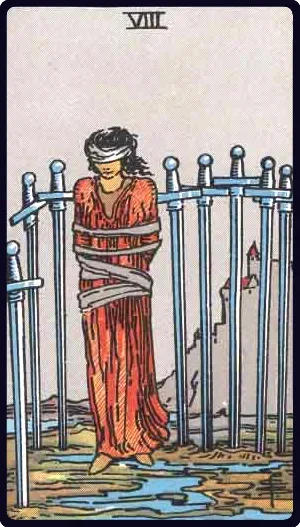
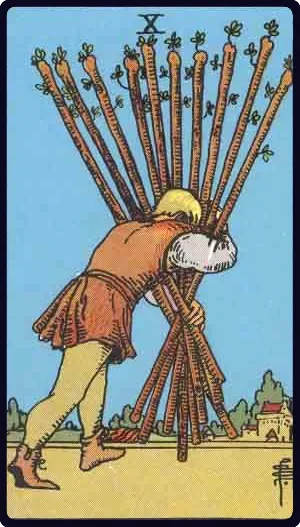
This combination is about a trap a person walked into themselves. The Ten of Wands bends under ten staves, with refusing it seemingly impossible. The Eight of Swords adds binding and fear: the ropes are not real, yet the person believes there is no way out. Together the cards describe the state where the load has become a cage: you haul it all alone while convinced you have no right to set it down. The trap lives largely in the mind, and so does its key.
General Meaning of the Combination
At the core sits a simple formula: the burden of the Ten of Wands plus the trap of the Eight of Swords equals the feeling of being a prisoner of your own load. The Ten shows real overload, while the Eight adds that you feel powerless to change things even though the exit is near. On the card the ropes are loose and the blindfold is not fixed: the limits are mostly inner ones, born of fear and a sense of duty. The person has convinced themselves they must carry everything and have no right to refuse, so they do not even try to set the load down. The combination often appears when fear of judgment or guilt holds tighter than the obligations themselves. The Ten of Wands adds physical exhaustion, the Eight of Swords a mental paralysis, and together they create a sense of deadlock. Yet the moment a person sees they tied the ropes themselves, the chance to untie them appears.
In Love and Relationships
In relationships the pair speaks of a bond where one partner feels trapped by obligations. The Ten of Wands carries the household, the care, and the decisions, while the Eight of Swords insists that leaving or changing things is impossible. The person stays out of duty, fear of loneliness, or guilt, though there is little joy left in the union. A sense of a cage arises, one whose door you locked yourself. For singles the combination shows a fear of new relationships as just another burden that will bind you again. The card advises seeing that there is always a choice, and not mistaking duty for a prison.
In Work and Finances
In work and finances the combination describes overload in which the person feels cornered. You juggle several projects at once, no help in sight, and you are sure you can neither delegate, refuse, nor leave. The Eight of Swords paints a dead end: any step seems to mean a loss, so enduring feels easier. In truth the limits are usually imagined, and part of the load could have been shed long ago. In money it is the fear of taking a risk and changing things that keeps you in a familiar but unloved bondage. The card advises soberly checking which of your ropes are real and which you drew in yourself.
If a Card Is Reversed
Eight of Swords reversed, Ten of Wands upright
The trap opens and the person sees a way out, but the load stays for now: fear recedes, clarity arrives that the situation can change, though the burden is still on the shoulders. This is the first step toward freedom: you stop seeing yourself as a prisoner and start looking for what to set down. In love it is realizing you can leave or renegotiate, in work it is grasping that some tasks can genuinely be handed to others.
Eight of Swords upright, Ten of Wands reversed
The load begins to lift, but the sense of confinement lingers: the tasks ease, yet the habit of feeling bound remains. The person is freed on the outside but still caged inside by fear and duty. In relationships it is leaving a heavy bond without inner relief, in work it is finishing a project after which you reflexively seek a new burden to feel needed and cornered again.
Both cards reversed
Both the trap and the overload ease at once: the ropes fall away, the load lifts, and a real chance to breathe appears. Yet there is a risk of bewilderment, when after long confinement the person does not know what to do with relief. In love it is stepping out of the cage and an unfamiliar sense of space, in work it is release from draining obligations and the search for a healthier foundation in place of the old bondage.
The Cards' Advice
Check whether your ropes are real. The Eight of Swords and Ten of Wands together advise you to see that most of the confinement is made of fear and a sense of duty, not actual dead ends. You carry a heavy load and have convinced yourself you may not set it down, but that is not true. Take one step: ask for help, drop the extras, test the limits. The moment you push the cage door, it turns out it was never locked.