Six of Swords and Ten of Swords Combination in Tarot
The Six of Swords and Ten of Swords tarot combination meaning: general sense, in love and work, reversed variants, and advice.
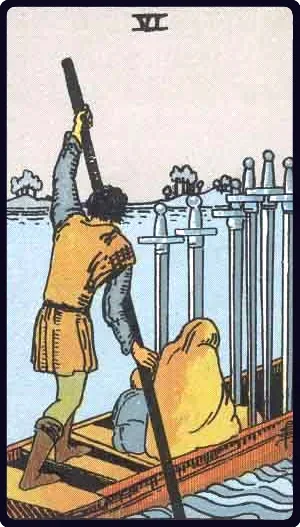
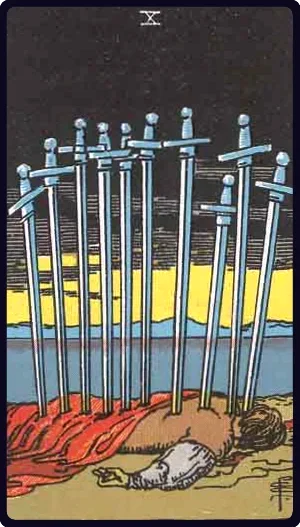
In short. The Six of Swords carries you away toward calm, while The Ten of Swords marks a painful ending, so together they speak of a hard close that calls for a transition.
This pairing is about leaving pain for peace after a complete collapse. The Ten of Swords is a bitter finale, betrayal, or rock bottom, below which there is nowhere left to fall. The Six of Swords is movement from that storm into quiet waters, a slow recovery. When they meet in a reading, the matter is a hard stage that has ended and the road away from the ruins: the worst is behind, and the path toward calm begins.
General Meaning of the Combination
At the core of the pair sits a formula: the ending of the Ten of Swords plus the transition of the Six of Swords equals leaving pain for peace. The Ten of Swords reports that some story has ended in the heaviest way: collapse, betrayal, loss, or a sense of complete dead end. The Six of Swords picks it up: since rock bottom is reached, the only way is to rise and move away toward quiet waters. Together the cards describe a turning point, where the pain has already happened, but beyond it a road of recovery opens. This is not a promise of ease but an honest admission: it hurt, and now you must slowly travel away from the ruins toward a new chapter. The core message: since it cannot get worse, any movement leads upward, and the transition after such an ending becomes the start of healing.
In Love and Relationships
In relationships this pairing speaks of a hard ending followed by healing. The Ten of Swords shows a painful finale: cheating, betrayal, or a final breakup after which it feels as if everything has collapsed. The Six of Swords brings calm movement away from that pain toward a quieter chapter. Often it is leaving a relationship that has hit rock bottom, and a slow recovery after the blow. For a couple it almost always means a parting rather than saving the union. For singles the cards advise not to stay stuck in the wound but to let yourself travel from the past toward peace. The pain is real, but the road forward leads to relief.
In Work and Finances
In work and finances the pair describes a collapse followed by recovery. The Ten of Swords conveys a failed project, a layoff, a partner's betrayal, or a financial rock bottom, when it feels as if everything is over. The Six of Swords suggests that after this ending a road opens toward a calmer setting. Often it is leaving a job that drained you to exhaustion, or shutting down a failing venture and starting with a clean slate. In money matters the combination acknowledges the loss but reassures: the worst is behind, and a gradual righting lies ahead. The point is not to cling to the wreckage but to move away toward a new, steadier stage.
If a Card Is Reversed
The Six of Swords reversed, The Ten of Swords upright
The ending has happened, but the transition has stalled: the person is stuck in the pain and cannot move from the ruins toward calm. The Ten of Swords is at full force, and the road away seems missing. In love it is being stuck in grief after a breakup, when letting go does not work, in work it is lingering on the ashes of a failure with no strength to start a new path.
The Six of Swords upright, The Ten of Swords reversed
The worst is already past and recovery begins: the pain winds down, and the transition to calm comes more easily. The person climbs out of rock bottom and moves away, feeling that the finale, however hard, is in the past. In love it is healing after a parting and a calm step toward a new chapter, in work it is recovery after a failure and a shift to a steadier setting without the old hopelessness.
Both cards reversed
Both the pain and the movement hang suspended: the wound heals slowly, yet the transition does not come together, and the person is caught between collapse and recovery. In love it is a sluggish shuffling after a breakup, when the sharp pain has dulled but real peace has not yet come, in work it is a drawn-out exit from failure where you can neither return to the past nor step confidently into the new.
The Cards' Advice
Admit that it hurt, and let yourself travel away from the ruins. The Six of Swords and the Ten of Swords together remind you that rock bottom is already reached, which means any movement leads upward. Do not cling to the wreckage and do not return to the point of collapse again and again: move slowly toward quiet waters, and the transition after such an ending becomes the start of healing.