Scythe and Anchor Combination in Lenormand
The Scythe and Anchor Lenormand combination: a sudden break of a settled routine and end of stability, its meaning in love and work, and how this card order reads.
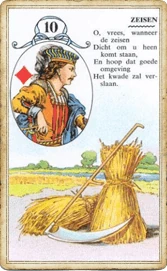
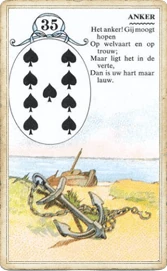
In short. The Scythe puts the sudden break in the lead, while the Anchor shows that what breaks is the settled and stable.
In this order the break itself becomes the leading theme, and the Anchor shows what it touches. The Scythe stands for sudden cessation and a decisive step, while the Anchor marks stability, work, and a settled routine. When the break leads, the spread says that what seemed firm and unchanging ends in a single stroke.
General Meaning of the Combination
In this order the sudden break is the leading theme, and the Anchor shows what exactly breaks. The Scythe names a sudden cessation, the cutting away of the excess, or a decisive step, while the Anchor clarifies that the blade falls on a familiar way of life: a stable job, a settled routine, or a long, reliable bond. Together the cards read like this: what stood firm for a long time ends in a single stroke, with no gradual fading. It may be dismissal from a long-held post, the break of a years-long routine, or the end of a drawn-out stagnation. The Scythe works fast and precisely, so the change comes abruptly and leaves almost no time to prepare. The combination also has a freeing edge: if stability had long turned into a weight, the break lifts that load and opens clean space. Much depends on the neighbors: heavy cards deepen the loss, bright ones soften it into a quick release from routine.
In Love and Relationships
In feelings the break comes first, and the Anchor shows that a firm, settled bond is ending. The Scythe points to a moment of truth, a sharp talk, or a sudden parting, while the Anchor says the blow falls on a long union with a shared household and a familiar routine. It may be the end of a relationship that held for years on stability but stopped bringing joy. If the bond had long turned into dull routine, the Scythe draws the line and frees you. The change feels final, since the Scythe does not stretch out the agony. For singles the combination advises letting go of an old attachment with no future, so something alive can take its place.
In Work and Finances
In work the sudden break leads, and the Anchor shows that something stable and proven is collapsing. The Scythe points to dismissal, a layoff, or an abrupt ending, while the Anchor clarifies that it concerns a permanent post, a reliable place, or a long, well-run business. It is the end of familiar work, arriving fast and in a single decision, drawing a line under a whole stage. In money the combination speaks of a sharp change where income was steady: a sudden drop in earnings, the cancellation of a long contract, or the end of a stable source. The advice is simple: assess it soberly and decide fast but with a cool head, so haste does not turn into loss.
Reverse Order
If the cards swap and the Anchor comes first, stability itself takes the lead, and the Scythe only shows the threat of a sudden break inside it. The accent then moves from the break to a settled way of life that faces an abrupt cessation, and it is more about a firm foundation under threat than an end that has already happened. This turn is covered in detail on the separate page Anchor and Scythe, where the support is the theme, and the Scythe warns it may snap.
The Cards' Advice
In this order the break is already in the lead, and it is not worth delaying. If the end of the familiar way of life has become inevitable, carry it out cleanly and clearly, without stretching the agony in circles. The Scythe asks you to cut precisely and without anger, while the Anchor reminds you that you are parting with something firm and well-worn, so decide thoughtfully. Sometimes the boldest step is to raise the anchor and change your mooring, letting go of what has long held you in place.