Coffin and Scythe Combination in Lenormand
The Coffin and Scythe Lenormand combination meaning: an ending that breaks off sharply and finally. Its sense in love and work, advice, and the reverse order.
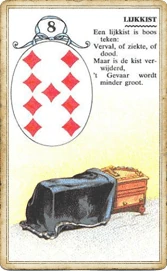
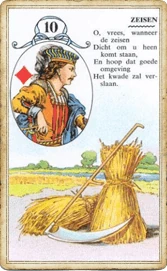
In short. The Coffin sets the theme of an ending, while The Scythe makes that close sharp and irreversible.
Here the Coffin leads: the matter is the close of a stage, the leaving of something worn out. The Scythe stands beside it as a qualifier and says this end will not be gentle. What was already heading to a finish is cut off in a single stroke, with no long goodbye. The combination describes a sudden, final point where you might have expected a gradual fading.
General Meaning of the Combination
The Coffin names the topic: a period, a matter, or a bond has run its course and is losing strength. The Scythe qualifies the nature of that ending, adding sharpness and finality. Together the cards read as a sudden and irreversible break in what was closing. This is not a slow decline but a clear line drawn in one stroke. Sometimes the pairing speaks of a heavy loss, sometimes of a decisive cut to what had long dragged you down. The Scythe also carries the image of harvest, so the pair can mean you are reaping the final result of the past. The neighboring cards show exactly what this finish touches, but the tone is set hard: there is no return to the old shape.
In Love and Relationships
In relationships the Coffin leads toward the close of feelings or of the couple's former shape, and the Scythe turns this into a sharp break. A bond that was cooling ends suddenly and without long explanations, often after one decisive conversation. The combination speaks of a separation that feels final and protects what remains of your self-respect. For a single person it is a signal to release an old attachment in one motion, without stretching out the goodbye to something that has no future.
In Work and Finances
In work the Coffin shows the close of a stage: a project ends, a role goes, the former position has exhausted itself. The Scythe makes this finish fast and unavoidable. It can mean a sudden layoff, an abrupt shutdown of a direction, or a loss that arrives with no warning. The combination advises you not to cling to what is ending anyway but to close the accounts calmly. After such a break, clear space often opens, yet you should act with a cool head, since a sharp step here is irreversible.
Reverse Order
If the Scythe falls first and the Coffin qualifies, the emphasis shifts. Then the theme of a sharp rupture leads, and the Coffin shows that this blow leads to a full close and loss. Here the action comes first, then its heavy outcome, whereas in the Coffin and Scythe order the finish is set first and the Scythe only makes it sudden. The difference lies in what comes to the front: the close of a stage or the cutting motion itself. For more on that direction, see the page Scythe and Coffin.
The Cards' Advice
Accept that this end will be sharp, and do not try to stretch it into a soft goodbye. If something is leaving anyway, it is better to cut the remainder in one motion than to drag it out and suffer. Make the decision with a clear head, free of the moment's emotion, since there will be no way back. Beyond the line, space will open, and only then is it time to think about the new.