Whip and Child Combination in Lenormand
The Whip and Child Lenormand combination: a conflict that touches a child or a beginning, meaning in love and work, and how the card order reads.
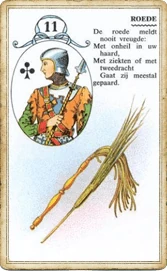
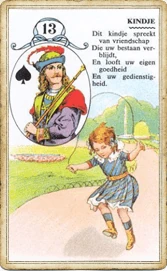
In short. Whip sets the theme of a quarrel, while Child makes it small and tied to children or a fresh start.
This is a difficult but softened pairing, and in this order the conflict speaks first. The Whip stands for arguments, confrontation and recurring tension, while the Child shrinks its scale and lends a shade of naivety. When the dispute leads and the Child qualifies, the spread points to a minor scuffle, a quarrel over a child, or the repeated mistakes of a beginner still learning the ropes.
General Meaning of the Combination
In this order the leading theme is conflict, and the Child shows that it is small and tied to something young or just beginning. The Whip describes a dispute, a clash and looping tension, while the Child eases the heat and adds the note of childhood, innocence and first steps. Together the cards read like this: a small quarrel that flares up quickly and is just as quickly forgotten, or a conflict sparked around a child and its needs. Often the pair speaks of repeated mistakes through inexperience, when a person argues and takes their knocks while mastering something new. The looping quality of the Whip is gentled here: the dispute is childish, without deep enmity, and with a calm tone it settles easily. The surrounding cards reveal whether this is a literal quarrel about children or an immature clash at the outset.
In Love and Relationships
In love the conflict comes to the front, while the Child keeps it light and almost teenage. The Whip shows quarrels, nitpicking and the clearing of the air, while the Child says they are small, naive and do not break the bond. For a couple this can be a dispute over a child or plans for children, or a childishly petulant tiff that passes fast. For a single person the pairing describes a meeting where attraction and light bickering sit side by side from the first minutes, the way teenagers spar. This is not serious enmity but a lively, sincere clash of characters that a simple conversation smooths over.
In Work and Finances
At work the conflict stays in the lead, while the Child points to its small scale and its link to a newcomer. The Whip shows a dispute in the team, friction or a fight, while the Child says the matter concerns a beginner, a learner, or a small repeated slip. These can be clashes at the start of a project, when inexperience forces rework and argument, or conflict around work with children. In finances the pair points to small money disputes and naive spending that stirs disagreement. The sums here are modest, and the quarrel is more of a working wrinkle than a serious threat.
Reverse Order
If the cards switch and the Child comes first, the leading theme becomes a new beginning, and the Whip only colours it with tension. The accent then shifts from conflict to a start, a young venture, or a child around whom a dispute arises. This reversal is covered in detail on its own page, Child and Whip, where the beginning or the child is the lead theme and the quarrel becomes its anxious companion.
The Cards' Advice
Do not blow a small quarrel up into serious enmity. In this order the conflict is minor and naive, so what is needed from you is a calm, grown-up tone: name the problem plainly, hear the other side, and do not pick at trifles. If the dispute revolves around a child or a new venture, remember that inexperience is cured by patience, not pressure. Settle the matter on its merits at once, before it turns into a repeating loop.