Cross and Anchor Combination in Lenormand
The Cross and Anchor combination in Lenormand: a prolonged trial that settles in for the long haul, its meaning in love and work, and how the order reads.
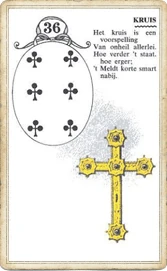
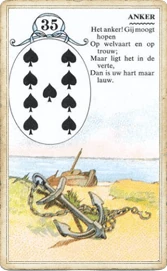
In short. Cross sets the theme of burden and trial, while Anchor shows that this load has settled in and become a familiar footing.
In this order the weight speaks first, and the Anchor defines how long it lasts. The Cross stands for trial, duty, and a hard lesson, while the Anchor adds permanence and a slow pace. When the burden leads, the spread describes a difficulty that does not flare and fade but settles in firmly, turning into long, drawn-out patience that drags on slowly.
General Meaning of the Combination
In this order the leading theme is the trial, and the Anchor qualifies it as something that has settled in for the long haul. The Cross shows burden, duty, and a hard period, while the Anchor lends it durability and a slow course. Together the cards read like this: the difficult stretch does not resolve quickly, it locks in and becomes part of the familiar routine. This is patience that stays a foundation for a long time, a load a person gradually learns to carry day after day. The combination is serious and slow, since both cards speak of endurance rather than movement. It often appears when a difficulty is no longer sharp but refuses to leave. Keep the timing in mind: the Anchor prolongs what the Cross sets, so quick relief is unlikely, and it matters more to settle into the hardship so it does not drain your strength.
In Love and Relationships
In feelings the trial leads, and the Anchor speaks of its length. The Cross shows a bond sustained through effort or duty, while the Anchor adds that this state has locked in and holds for a long time. For a couple it describes a relationship where the hardship has become familiar, where patience has turned into a way of life, and the partners carry a shared load for years. Sometimes this is loyalty despite the weight, sometimes being stuck in a bond held by duty. For a single person the cards speak of an old pain that has settled in deeply and blocks opening up. It is worth asking whether this patience is a support or a weight to release.
In Work and Finances
In work the weight of responsibility leads, and the Anchor shows that it has become permanent. The Cross describes a load of duties, forced patience, or work that comes only through effort, while the Anchor adds that this position has locked in and holds day after day. This can be an oppressive routine, a project that drains you but will not let go, or a role you carry out of duty for years. Here stability turns into stagnation and reliability into a yoke. In finances the cards speak of a long-term obligation, a loan, or an expense that drags on steadily. The advice is simple: do not take on more than you can carry evenly.
Reverse Order
If the cards fall the other way and the Anchor comes first, stability itself becomes the lead, and the Cross only colors it with a tone of weight. Then the focus shifts from the trial to a settled situation that has turned into a burden, to routine and stagnation that have become a load. This reversal is covered in detail on its own page, Anchor and Cross, where the leading theme is the durability itself, and the Cross adds heaviness, a yoke, and forced patience.
The Cards' Advice
Settle into the hardship so it does not drain your last strength. In this order the trial has already locked in for the long haul, so what you need is not struggle but calm, even patience. Do not try to throw off the load in one pull, and do not carry everything alone, share the weight where you can. The Anchor reminds you that a long stretch holds a firm support inside itself, and the one who learns to carry calmly gradually turns the weight into a foundation.