Coffin and Woman Combination in Lenormand
Coffin and Woman Lenormand combination meaning: an ending tied to a woman, her departure or a hard period. Meaning in love and work, and how card order affects it.
In short. The Coffin brings an ending, while the Woman points to a specific person, so together they speak of an ending tied to a woman or a hard period for her.
This is a personal combination with a living person at its center. The Woman, a significator card, marks the female querent or a significant woman for a man, while the Coffin colors her with the theme of ending, downturn, or loss. Side by side they say this woman is living through the close of a stage or a decline in strength. It is not an event but a person at the edge of a change, and the neighboring cards specify what is ending for her.
General Meaning of the Combination
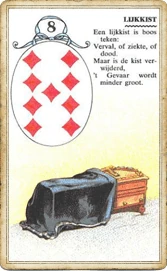
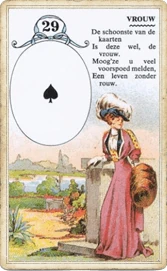
The formula of the pair is simple: the ending of the Coffin plus the specific person of the Woman equals a close tied to that woman. The Woman is neutral on her own and says almost nothing. A neighboring card gives her meaning, and here that neighbor, the Coffin, brings the theme of an ending. Together the cards describe a woman living through an ending: a parting, leaving an endeavor, a decline in strength, or the end of a hard period. Sometimes it concerns her leaving or pulling away, sometimes a hard period she is living through, sometimes a decision to let something go and bring it to a close. The Coffin sets a mood of downturn and pause, while the Woman shows that this theme is tied to a specific person rather than to abstract circumstances. To understand which area the ending touches and how heavy it is, look at the rest of the line, especially the card the figure faces.
Love and Relationships
In relationships the Coffin and the Woman most often speak of an ending tied to this woman. If a man is asking, the combination can point to his partner’s cooling feelings, distance, or decision to end the bond. If a woman is asking, the cards describe her at the edge of a parting or the close of a hard stage in her feelings. It is a period when the former shape of the relationship fades and pretending no longer works. For a single woman the combination advises releasing a past attachment and giving the heart time to recover.
Feelings, Thoughts and Intentions
Feelings. The pair Coffin and Woman describes emotional exhaustion and distance experienced by this woman. Her feelings may have cooled, and she may feel tired and wish to withdraw.
Thoughts. Thoughts focus on ending the relationship or phase, on the need to accept change and let go of the past. The woman may be reflecting on how to maintain inner peace and cope with emptiness.
Intentions. Intentions include a desire to pause, rethink the situation, or end the bond. She may be ready to release and give herself time to recover, avoiding prolonging a relationship that has run its course.
Career and Work
At work and in financial matters the pair points to an ending with a specific woman at the center. It can be the departure of a colleague, a manager, or a partner, or the close of a joint venture. If the card stands for you, the combination speaks of your own close of a stage: leaving a place, closing a project, or the sense that the former work has exhausted itself. The Coffin brings the theme of downturn and ending, while the Woman ties it to a person.
Try our readings
Finances
In finances the combination may show a woman through whom a money flow ends, or the close of a financial arrangement tied to her.
Health
The pair symbolizes exhaustion and decline in the woman’s strength, urging gentle self-care. It is important not to ignore fatigue, maintain rest routines, and seek support if needed to prevent her condition from worsening.
Situation and Question
The situation is described as an ending tied to a specific woman. This may be the conclusion of a relationship, project, or life period. The main task is to acknowledge the ending, not resist change, and allow oneself time to calmly live through this stage to prepare for what comes next.
Reverse Order
If the cards fall the other way and the Woman comes first, the person becomes the main focus, while the Coffin only shows what is happening to her. Then the emphasis shifts from the finish to the woman herself, and the Coffin describes her state or decision: she is living through a decline in strength, a hard period, or she herself draws the line, lets go, or leaves. This order is covered in detail on its own page, Woman and Coffin, where the person serves as the leading theme, and the ending becomes her state or a deliberate choice.
The Cards' Advice
If the combination speaks of another woman, see her position honestly, without illusions: she is living through an ending and may need time and space. If the card stands for you, it advises calmly releasing what has already faded and giving yourself a pause to recover. Do not rush the change or blame yourself for being tired. An ending is a natural part of the path, and clarity follows a calm goodbye to the old.
Coffin Combinations
Everyone Reads at Astralika
Enough theory: time to ask the Lenormand cards a question of your own. There are 346 readings on love, work, health and more.