Coffin and Letter Combination in Lenormand
The Coffin and Letter combination in Lenormand: news of an ending, a document closing a matter, meaning in love and work, and how the card order changes it.
In short. Coffin puts an ending at the center, while Letter shows that word of it will arrive in writing.
In this order the ending leads, and the Letter describes the form in which it reaches you. The Coffin speaks of the close of a stage, a downturn, and the need to release what has faded, while the Letter turns that into a document or message. With closure in front, the pair reads as news of an ending, a document that brings matters to a close, or word that something is no more.
General Meaning of the Combination
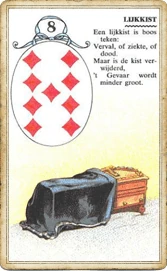
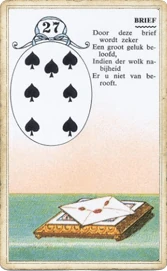
In this order the leading theme is the ending, and the Letter shows it will reach you through text. The Coffin speaks of the close of a stage, loss, and decline, while the Letter records that ending in writing: a notice, a termination agreement, a message that brings matters to a close. Together the cards read this way: something faded is closing, and you learn of it from a document or letter rather than through a conversation. It may be a refusal, a cancelled document, the end of correspondence, or an official confirmation that things cannot return to the way they were before. The Letter is neutral on its own, and the weight in this pair comes from the Coffin, so the news here is more often sad or stern. Yet the combination has a calmer side too: sometimes it is the close of a long matter on paper, the end of an obligation, after which relief arrives.
Love and Relationships
Emotionally, the ending comes first, and the Letter says you will learn of it through words. The Coffin shows a cooled bond, distance, and the close of a familiar form, while the Letter turns this into a message: a cold text, a final letter, news of a breakup from afar. For a couple the combination often describes a conversation that brings things to a close, or a silence broken by an honest but sad message. For someone single, it advises closing an old chat and releasing a person who left long ago. It is not an easy pair, but it helps you see the ending clearly and put it into words.
Feelings, Thoughts and Intentions
Feelings. The pair conveys emotional fatigue and distance. The Coffin brings a sense of exhaustion and fading closeness, while the Letter adds a desire to express these feelings through words, perhaps via a farewell message or official notice.
Thoughts. Thoughts focus on recognizing the end of a relationship or phase. There is a need to understand and accept closure, alongside a wish to receive or send information that helps finalize this chapter.
Intentions. Intentions are aimed at honestly and calmly formalizing the ending through words: writing, getting a reply, or documenting the situation. This is not about reviving the past but about readiness to let go and move forward.
Career and Work
At work the ending leads, and the Letter puts it in writing. The Coffin shows the close of a project, leaving a company, or a finished deal, while the Letter puts this in a document: a resignation, a termination notice, a rejection of your application. The combination says the ending at work will be made official, through text rather than by word of mouth.
Finances
In finances the pair points to a financial document recording an ending: a closed account, a settled debt, a final receipt, or notice that payments have stopped. More often it is a downturn or the end of an inflow, but sometimes it speaks of release from an obligation that a document closes.
Health
The pair advises gentle care for health, acknowledging the need for rest and support. The Coffin reminds you to take care of yourself, while the Letter suggests waiting for examination results and avoiding premature conclusions, helping reduce unnecessary stress.
Situation and Question
The situation is described as an inevitable ending that has occurred or is near. The Letter indicates you will soon receive official communication or information that clarifies and confirms this fact. The next step is to accept the news calmly and not resist change, allowing time to adjust.
Reverse Order
If the cards fall the other way and the Letter comes first, the message itself becomes the lead, and the Coffin only colors it with the tone of ending and sadness. The emphasis then shifts from the ending itself to the message arriving, which brings bad news or closure. This reversal is covered in detail on its own page, Letter and Coffin, where the messenger leads and the ending becomes the content of the letter.
The Cards' Advice
Accept the news of the ending calmly and do not argue with the paper. In this order the ending is what brings things to a close, and the Letter only brings it in recorded form, so read the news carefully and to the end. Do not cling to what has faded or try to revive what a document has already closed. If a reply is needed, answer honestly and without haste, then give yourself time to live through the change. Behind the closed page, room opens for something new.
Coffin Combinations
Everyone Reads at Astralika
Enough theory: time to ask the Lenormand cards a question of your own. There are 346 readings on love, work, health and more.