Heart and Coffin Combination in Lenormand
The Heart and Coffin Lenormand combination: feeling leads, the Coffin marks its ending. Meaning in love, work, the reading order, and FAQ about the pair.
In short. Heart leads with the theme of love, while Coffin speaks of the ending of that feeling.
In this pair the Heart comes first, so the reading is about feeling, affection, and attachment. The Coffin in second place colours the love with the theme of closure: the feeling fades, cools, or comes to an end. This is one of the saddest combinations in the love theme, about the ending of something that was dear.
General Meaning of the Combination
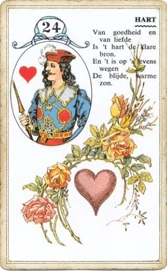
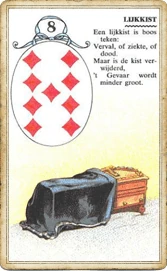
The Heart sets the theme of love and emotional warmth, and the Coffin in second place adds the sense of an ending and loss. Together the cards speak of the close of a feeling: the attachment that once warmed you fades, cools, or leaves. The Heart shows that this concerns something truly dear, while the Coffin, a challenging card, brings sadness and weight to it. The pain is here precisely because the feeling was real. Yet the Coffin speaks not of physical death but of the close of a stage: some form of love has run its course and is closing, making room for something new. With positive surrounding cards the pair can mean a quiet goodbye and relief after a hard stretch, release from a relationship that was wearing you down. With heavy surrounding cards it underlines loss and heartache.
Love and Relationships
In relationships the Heart with the Coffin speaks of an ending to the familiar shape of a bond. This may be a breakup, a divorce, or the close of a phase within a couple, after which the feelings will not be the same. What once held you together has cooled or shifted, and the card shows this chill honestly. Sometimes the combination describes not a clean break but emptiness: a person feels boxed in, with no room to breathe. For singles the pair advises closing an old story, releasing a past love or the image of a person who left long ago, and giving the heart time to heal before opening to anything new.
Feelings, Thoughts and Intentions
Feelings. This pair reflects sadness and fatigue from fading attachment. There is a sense of loss of something once dear that warmed the soul.
Thoughts. Thoughts focus on the need to acknowledge the end of a relationship or phase, understanding that former feelings are changing and require reconsideration.
Intentions. The intention is to allow oneself and the partner time to heal, not rush into new feelings, and calmly experience the farewell to prepare for a new stage.
Career and Work
At work the Heart with the Coffin speaks of a pursuit you loved that has come to an end. The beloved occupation has exhausted itself, the interest has faded, and efforts to revive it no longer work. This may be leaving a vocation close to the heart, the close of a project you poured your heart into, or the end of warm ties within a team. The combination advises closing accounts calmly rather than clinging on.
Finances
In finances the pair points to a downturn in a money matter coloured by feeling: the end of income from work you love, or the close of an obligation toward a dear person. Bright neighbours soften this into relief. Heavy ones deepen the loss.
Try our readings
Health
The pair symbolizes emotional exhaustion and the need for gentle self-care. Make time for rest and do not ignore bodily signals to maintain mental and physical balance.
Situation and Question
The situation describes the end of an important phase connected to feelings and attachments. The main obstacle is reluctance to accept closure. The next step is to embrace change, allow time for reflection, and calmly let go of the past.
Reverse Order
If the cards swap places, the theme of an ending leads and feeling colours it. In the pair Coffin and Heart closure and loss stand first, while the Heart qualifies that the ending touches love itself: cooled feelings, grief for a past bond, a goodbye to what was dear. There the main theme is the ending, and love is only the area where it happened. In our order, by contrast, the anchor is the feeling, and the Coffin says it is fading. The sense of both pages is close and sad, but the emphasis differs: where the feeling sits versus the ending itself.
The Cards' Advice
Release what has already ended and do not cling to cooled feelings. The combination advises you to acknowledge the close honestly, without suppressing the grief or blaming yourself for it. An ending is a natural part of the path, and as long as you hold on to what is leaving, moving forward stays hard. Give the heart time to heal, live through the goodbye calmly, without rushing, and the pause will become a foothold for a new feeling.
Heart Combinations
Everyone Reads at Astralika
Enough theory: time to ask the Lenormand cards a question of your own. There are 346 readings on love, work, health and more.